“So far, fewer than 120 have been discovered,” continues Morita. “It’s also important symbolically. All the elements before were discovered in the West, and it is wonderful that we now have an element discovered in Asia.”
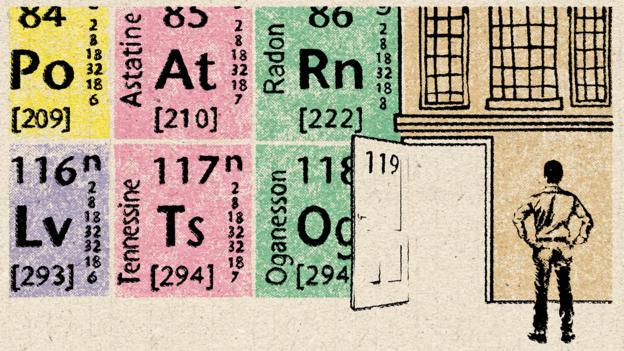
Now Morita and his team are racing towards the discovery of another new element that will kick off the eighth row on the periodic table. Element 119, provisionally called ununennium, is still a hypothetical element that would be the seventh alkali metal with similar properties to the other volatile substances in this group, including lithium, sodium, potassium and caesium.
Synthesising it and then detecting it will be no easy task, though.
“Element 119 will require months of irradiation of a curium target with an intense vanadium beam,” says James Roberto, associate laboratory director for science and technology partnerships at Oak Ridge National Laboratory in Tennessee, US. Even then the amount of 119 that will be produced are likely to be tiny and incredibly short-lived. Ensuring the curium target can survive such long periods of bombardment in good enough condition to still be viable will also be a challenge.
And the Japanese team are facing intense competition from other groups around the world, including a team at the Joint Institute for Nuclear Research in Dubna, Russia, led by Yuri Oganessian, the physicist whose name is now carried by the heaviest element to be discovered so far, Oganesson, which he helped synthesise for the first time in 2002. The Russian team have a formidable track record, discovering the four heaviest known elements in the periodic table, 114-118.
Both teams are using the hot fusion reaction to find element 119, the same method Oganessian’s team used to discover elements 114 to 118, where extremely high temperatures are used to fuse nuclei together. The Russians plan on using a titanium beam to bombard a berkelium target, while the Japanese are using vanadium to bombard curium.
"modern" - Google News
February 05, 2020 at 08:34AM
https://ift.tt/37Z09f5
The modern alchemists racing to create a new element - BBC News
"modern" - Google News
https://ift.tt/33BJDyM

No comments:
Post a Comment