He is wrapping up 2018 by chatting with one of his most loyal supporters on Fox, Pete Hegseth. The phone interview is airing on the cable network's New Year's Eve countdown show.
With some notable exceptions, Fox has been Trump's shelter from the storms that are saturating his presidency. And Trump has generously promoted the network and its right-wing personalities with dozens of tweets and endorsements.
Traditional lines have been crossed or erased altogether. Trump seems to get his daily briefings from "Fox & Friends" and get directions from Sean Hannity and Jeanine Pirro.
During the partial government shutdown, Pirro, a Saturday night host, spoke directly to Trump through her opening monologue.
"I am pleading with you," she said, to keep up the fight for border wall funding.
Past presidents have had close connections to members of the media of course — but Trump and Fox have taken it to a whole new level. Throughout 2018, the second year of Trump's presidency, the relationship became even cozier. Some love the tight relationship, and others detest it. Critics have likened the set-up to "state-run TV," or the opposite, a "TV-run state." Comedian Jordan Klepper went with the "TV-run state" idea in a commentary last April: "Fox says it, Trump spreads it."
He definitely gathers intelligence and gains talking points from Fox's talk shows. That's evident from his tweets and remarks at rallies. And he hires people he sees on TV. In 2018, Fox contributor John Bolton became National Security Adviser. And Fox anchor turned State Department spokeswoman Heather Nauert was nominated to be Trump's ambassador to the U.N.
The revolving door went in the other direction too, with Fox host Kimberly Guilfoyle joining her boyfriend, Donald Trump Jr., at a pro-Trump PAC.
When Trump called Democrats "the dims" at an October rally, he credited his source: "The dims. Who says that? Lou Dobbs, the great Lou Dobbs, he says that."
Dobbs, Trump's biggest booster on Fox Business, also has the highest-rated show on Fox Business.
Similarly, the highest-rated shows on Fox News belong to pro-Trump hosts like Sean Hannity.
That's an important part of the answer to any question about whether Fox's support for Trump will waver in 2019, given the numerous criminal investigations and scandals surrounding Trump.
On "CNN Tonight" last week, host Don Lemon asked, "Do you think you'll see Fox break with this president?"
"I think it's impossible to say, but whatever Fox does is going to be one of the really accurate yardsticks for how Trump's presidency is going," New York Times op-ed columnist Frank Bruni said.
If Fox's current approach continues, "I think it's going to be ratings driven. It's going to be approval ratings driven," Bruni said. "And if Fox starts to turn on him, that is going to tell you that something's happening in the country at large, because they're going to look at that before they make any decisions."
When the headlines about Trump are especially damaging, Fox's ratings sometimes soften a bit, but the network remains remarkably strong overall. It has a lock on a significant part of the US population.
Case in point: 2018 was the network's third consecutive year as the most-watched channel on cable, both in prime time and throughout the day, surpassing ESPN.
Fox is more than its pro-Trump shows. The network has many frontline journalists and news anchors, some of whom bristle at the propaganda-like content that airs in the mornings and the evenings.
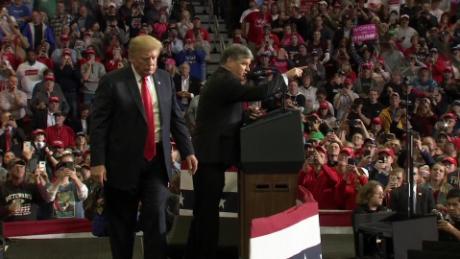
These tensions flared on the eve of the midterm election, when Hannity hosted his show from a Trump rally while claiming he was not there to campaign.
He came up on stage when Trump called his name, and declared that "all those people in the back are fake news." The press pen of journalists in the back included a crew from Fox.
Pirro came up on stage, too. Fox chastised the pair the next day, saying "Fox News does not condone any talent participating in campaign events" and calling the incident an "unfortunate distraction" that "has been addressed."
But in practice, Fox's biggest shows campaign for Trump almost every day. They defend his decisions, distract from his scandals and attack his opponents. Occasional squabbles get a lot of press — Tucker Carlson's criticism of Trump's airstrikes in Syria, for example — but those are the exceptions to the rule.
Trump has given 41 interviews to Fox since inauguration day, far more than every other major TV network combined.
One day in 2018, when Steve Doocy was co-hosting "Fox & Friends" from the North Lawn of the White House, Trump walked right outside and gave a lengthy interview.
Most of the interviews are with Trump's boosters, like Hannity and Doocy, and only a comparatively small number are with Fox journalists like Chris Wallace.
Earlier this year The Washington Post reported that White House advisers sometimes call Hannity the "shadow chief of staff."
Hannity's longtime producer and friend Bill Shine became Deputy Chief of Staff for Communications over the summer. Shine was co-president of Fox News when he was forced out in 2017. He is still being paid millions in severance and bonuses by Fox, even while working at the White House.
Meantime, Trump's former communications director, Hope Hicks, became the chief communications officer for Fox's parent company late in the year. Her very first press release announced Fox's corporate support for a Trump-backed criminal justice reform bill.
Hicks was brought aboard at a time of transition at Fox. The Murdochs are selling most of their assets to Disney in a deal that is expected to close in early 2019. The remaining assets, including Fox News and the Fox broadcast network, will be run by Rupert Murdoch's son Lachlan. Rupert will be co-chairman.
There's been rampant speculation over the years about how the Murdoch family's politics align with Fox. Observers have wondered if Lachlan Murdoch might try to moderate some of Fox's right-wing programming. But there's been no sign of that.
When asked at a conference if he's embarrassed by some of Fox's content, Lachlan Murdoch said, "I'm not embarrassed by what they do at all."
He defended Fox News as "the only mass media company in America with conservative opinions. It's the only one."
Left unsaid was perhaps the most important fact: Fox News is a huge profit engine for its parent company, thanks to reliable subscription fees from cable customers across the country.
The turnover at Fox in recent years — starting at the top with founding CEO Roger Ailes — proved that the network is far bigger than any single star. In the months after Ailes was ousted amid a sexual harassment scandal in July 2016, Greta Van Susteren, Megyn Kelly, and Bill O'Reilly all left, all for different reasons. The network didn't miss a beat.
In his own way, Trump is a Fox News star too. But all signs indicate that Fox is bigger than him, too.